GNN Molecular
Seven GNNs for Molecular Properties
Comparing seven graph neural networks at predicting how well molecules dissolve.
- ESOL RMSE 0.498
- R² 0.926
- 7 GNNs compared
Built with PyTorch
 PyTorch GeometricRDKitMoleculeNet (ESOL)
 pytest
Code is in a private repository for now.
Overview
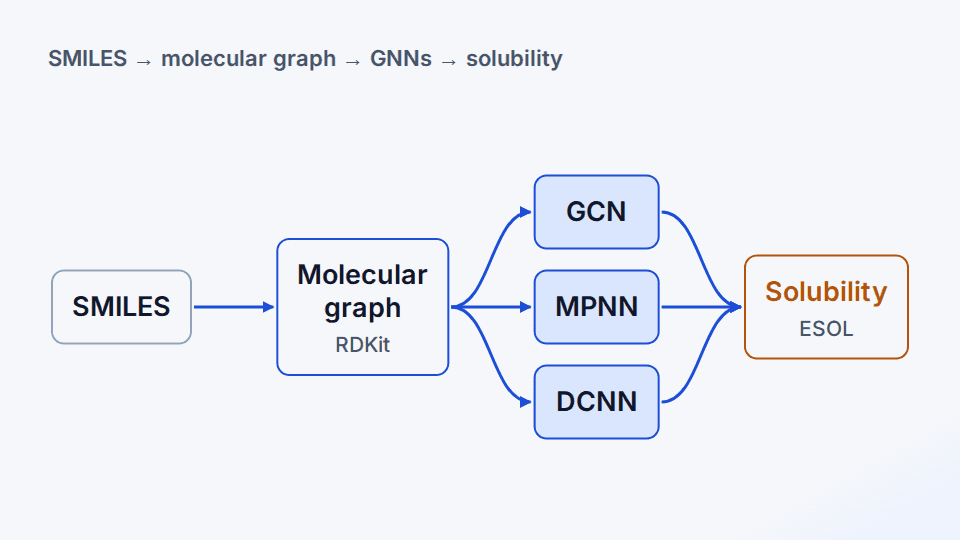
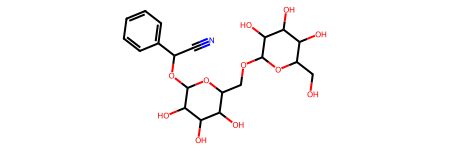
A molecule is naturally a graph: atoms are nodes and bonds are edges. I wanted to see how different graph neural network designs use that structure to predict a real chemical property, aqueous solubility, from the MoleculeNet ESOL benchmark.
I first implemented three architectures by hand in notebooks: a graph convolutional network (GCN), a message-passing neural network (MPNN) that also uses bond features, and a diffusion-convolutional network (DCNN) that spreads information over several hops. I later turned them into a tested Python package and added four standard models built from PyTorch Geometric layers: GIN, GAT (v2), GraphSAGE and AttentiveFP.
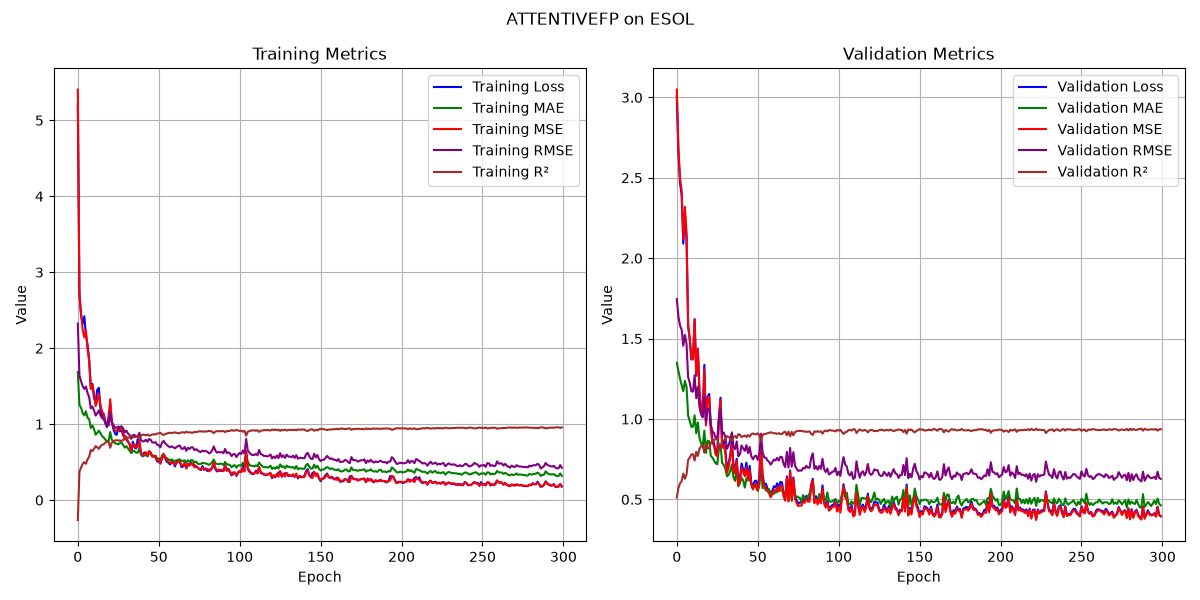
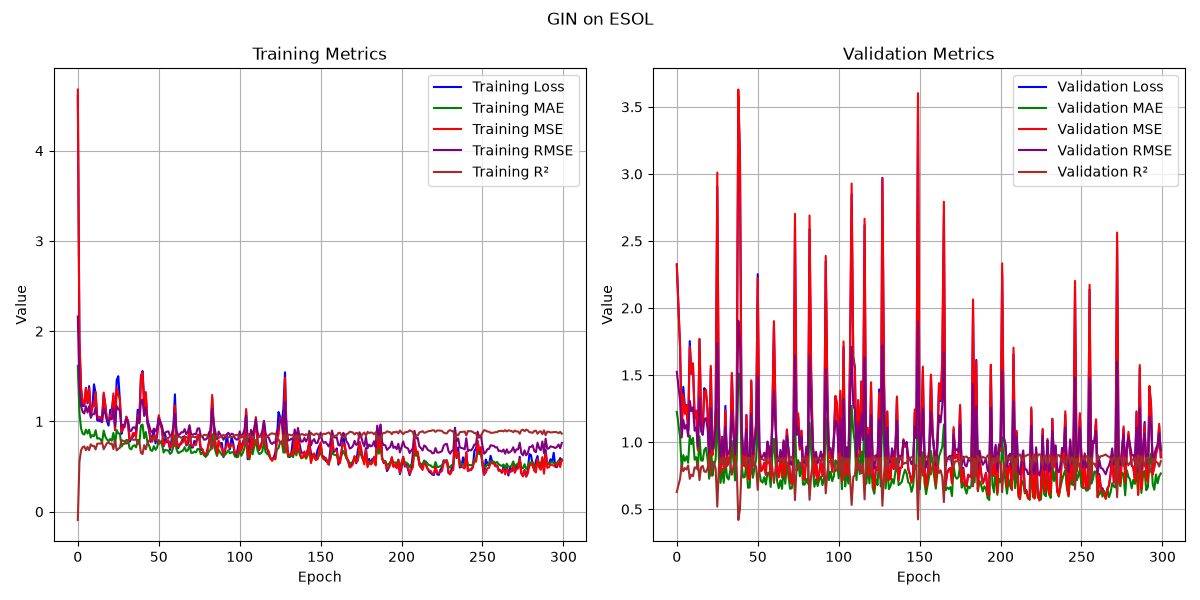
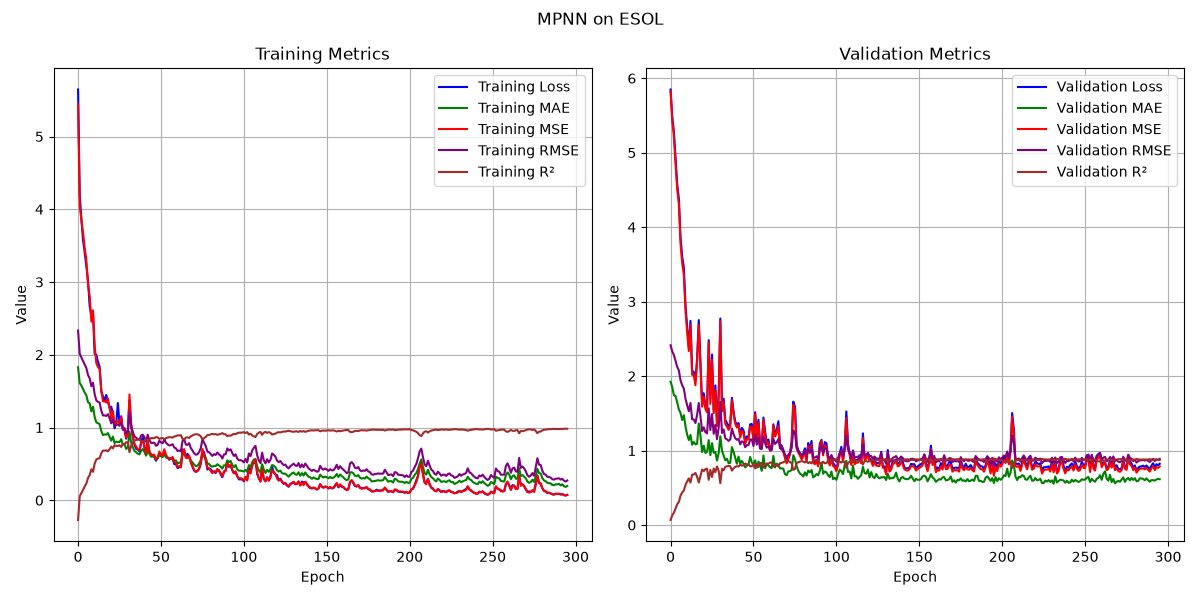
All seven run on the same seeded split with the same metrics. AttentiveFP (test RMSE 0.498, R² 0.926) and GIN (0.528, 0.916) lead, followed by the MPNN (0.645), GAT (0.769), GraphSAGE (0.816), DCNN (0.907) and GCN (0.981). The four models that read bond types come out ahead of the three that only see atoms.
The question
How do seven graph neural network designs compare at predicting molecular solubility (ESOL) directly from molecular graphs?
Key features
- Seven GNNs for graph-level regression, sharing one interface: GCN, MPNN, DCNN, GIN, GAT, GraphSAGE and AttentiveFP.
- SMILES-to-graph featurization with RDKit: 9 atom features and 3 bond features.
- Bond-aware models (MPNN, GIN, GAT, AttentiveFP) next to atom-only models (GCN, DCNN, GraphSAGE) for a direct comparison.
- Two commands: mgnn-train trains any model and reports test metrics, mgnn-predict scores any SMILES string.
- 75 pytest tests, including permutation invariance and equivariance and batch independence, run on every model.
- Seeded 80/10/10 split with MAE, MSE, RMSE, and R² tracked every epoch, plus early stopping on validation loss.
How it works
Molecules to graphs
ESOL molecules are loaded from MoleculeNet and represented as graphs of atoms and bonds, with molecules that contain isolated atoms filtered out where needed.
Batch the graphs
PyTorch Geometric merges many small molecular graphs into one disconnected graph per batch and keeps track of which atom belongs to which molecule.
Propagate information
Each architecture updates atom representations in its own way: graph convolution, learned messages over bonds, multi-hop diffusion, sum-and-MLP (GIN), attention over neighbours (GAT, AttentiveFP) or separate self and neighbour weights (GraphSAGE).
Pool and predict
Atom representations are pooled into one vector per molecule, which a regression head maps to a solubility value, trained with mean squared error.
Examples
Input
mgnn-predict --checkpoint checkpoints/mpnn/best.pt "CCO" "c1ccccc1"
Output
1.195 log(mol/L) CCO -1.633 log(mol/L) c1ccccc1
Tech stack
Model definitions and training loops
Graph layers (GCNConv, GINEConv, GATv2Conv, SAGEConv, AttentiveFP), message passing, and batching
Parse SMILES and inspect molecules
MoleculeNet (ESOL)
Molecular solubility benchmark
Unit tests for the models, data pipeline, and training loop
What I learned
- Bond features matter: every model that reads bond types beats every model that does not
- Sum beats mean: GIN's sum aggregation can count neighbours, so it clearly beats the mean-based GraphSAGE and GCN
- Tests catch real bugs: one found a DCNN mean pooled over padding, and an eval-mode check showed GraphSAGE had learned to depend on dropout
Limitations
- Single dataset (ESOL) and a single seed; private repository
Keywords
graph neural networks · GNN · GCN · graph convolutional network · MPNN · message passing neural network · DCNN · AttentiveFP · GraphSAGE · graph attention network · GAT · graph isomorphism network · GIN · diffusion convolutional neural network · PyTorch Geometric · PyTorch · RDKit · cheminformatics · molecular property prediction · molecular graphs · SMILES · MoleculeNet · ESOL · aqueous solubility prediction · drug discovery · deep learning