CartPole RL
Twelve RL Methods on One Benchmark
Every classic reinforcement-learning method, from a Q table to PPO and pixel CNNs, balancing the same pole under the same evaluation.
- 12 methods solve CartPole
- PPO solved in 15k steps
- Q-table solves in 4 s
Built with PyTorchGymnasium
 NumPyMatplotlib
 pytest
Overview
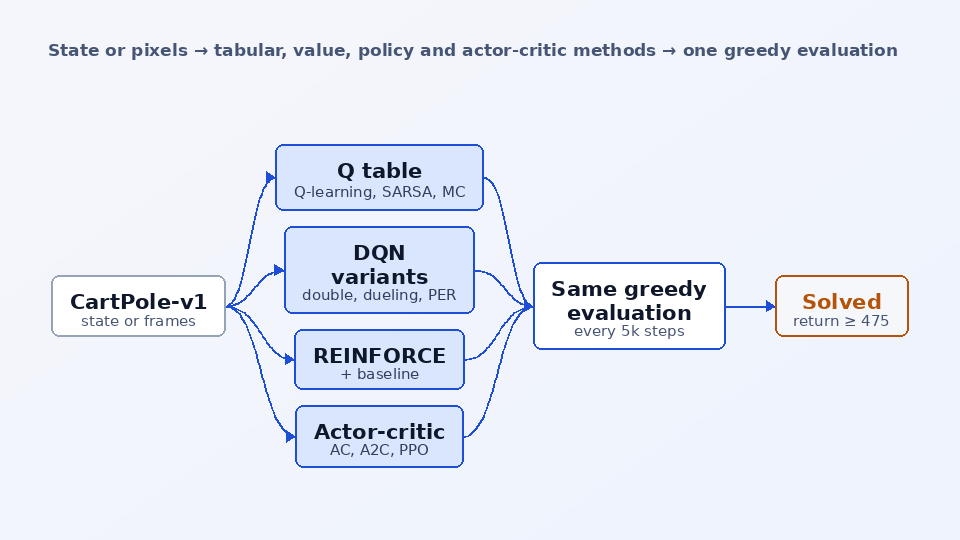
CartPole is the simplest control task in Gymnasium: push a cart left or right so the pole stays up, one point per step, 500 steps at most. I used it as a bench to implement every classic reinforcement-learning method myself and see how each one actually gets there: tabular Q-learning, SARSA and Monte Carlo control on a binned state, DQN with its double, dueling, prioritized-replay and n-step variants, REINFORCE with and without a baseline, one-step actor-critic, A2C and PPO, and finally CNN policies that only see rendered frames.
Everything shares one environment, one Recorder that counts steps and runs a greedy evaluation every 5,000 steps, one definition of solved (a 10-episode candidate at >= 475 confirmed on 100 more episodes), and the same plots. Each update rule is a few lines next to a comment that says why it is there, and 53 tests check the pieces (reward-to-go, GAE at lambda 0 and 1, the double-DQN target, the dueling head, PPO's clip) against numbers worked out by hand.
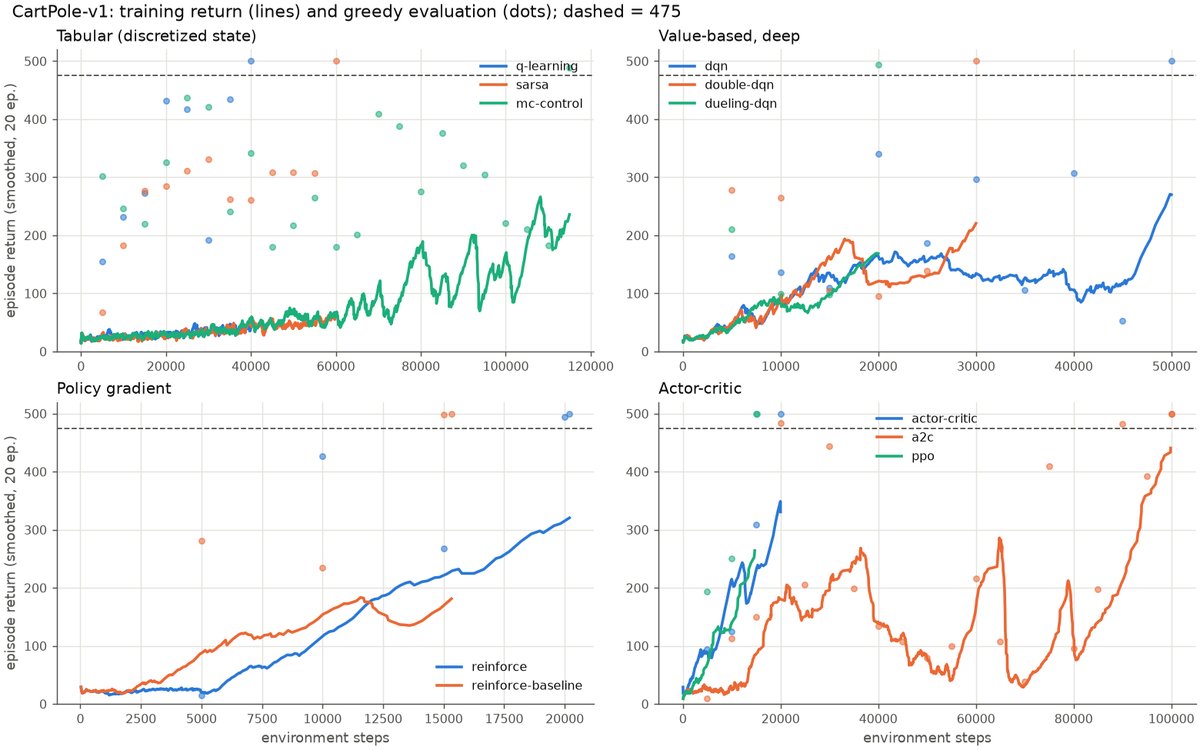
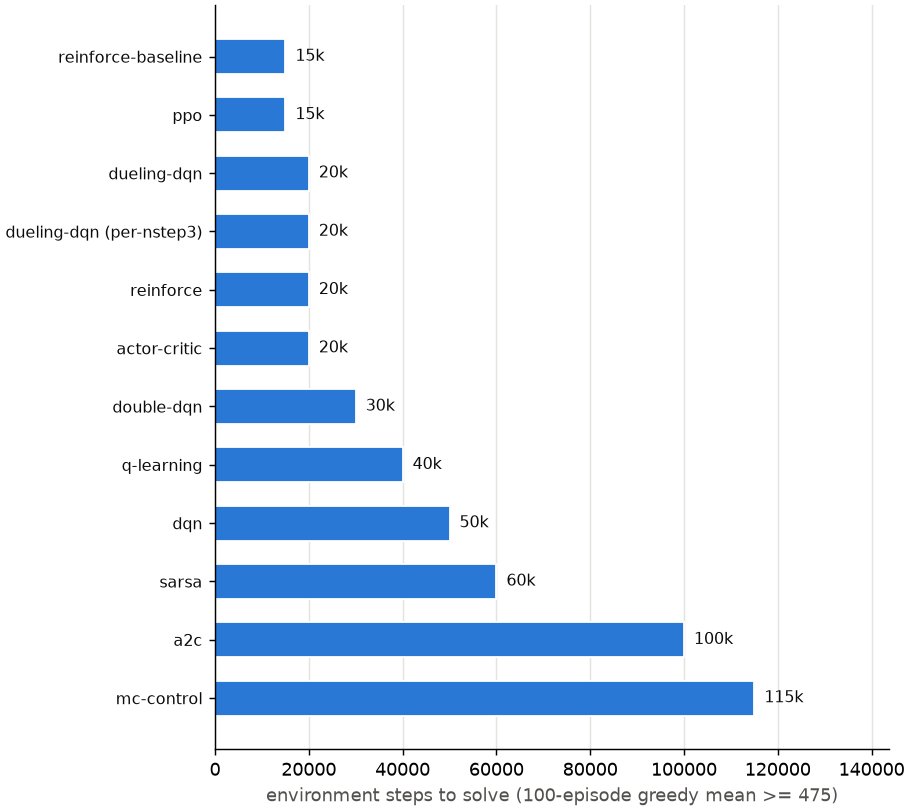
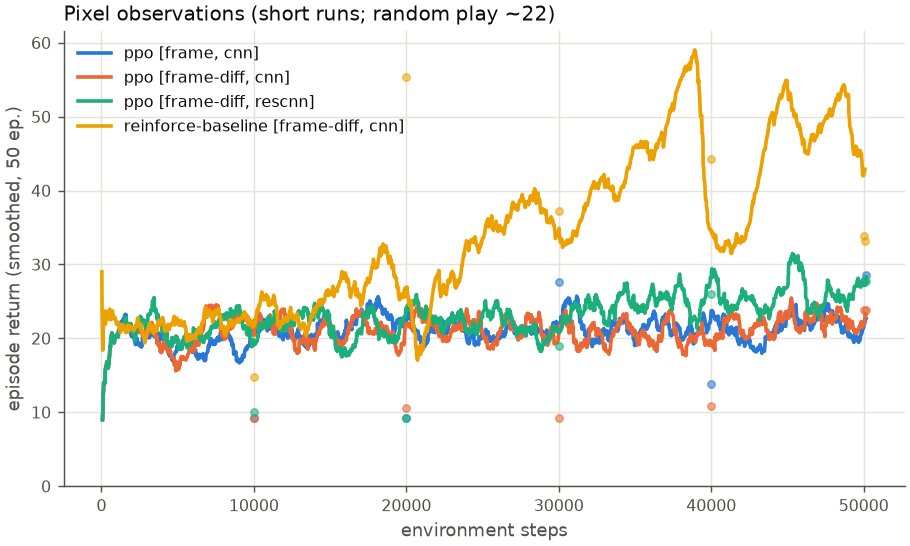
On state observations all twelve methods solve the task. PPO and REINFORCE + baseline do it after 15,000 steps, tabular Q-learning after 40,000 steps but only 4 seconds of CPU, and plain DQN after 50,000 steps with a long plateau that the double and dueling variants do not show. The pixel runs are the honest part: 50,000 CPU steps are far from enough, and only the frame-difference agents move above random play at all.
The question
If every classic RL method runs on the same environment with the same greedy evaluation, what does each learning curve reveal about why its ingredients (replay, target networks, baselines, clipping) exist?
Key features
- Twelve methods behind one
--methodflag: q-learning, sarsa, mc-control, dqn, double-dqn, dueling-dqn (plus--prioritizedand--n-step), reinforce, reinforce-baseline, actor-critic, a2c and ppo. - Three observation modes: the 4-number state, a 40x80 grey rendered frame, or the frame plus its difference from the previous one, with MLP, CNN and residual-CNN bodies.
- One Recorder for every method: step counting, periodic greedy evaluation on fixed start states, confirmed solve, and the best evaluated weights restored at the end.
- Truncation handled correctly everywhere: the 500-step time limit bootstraps from V(s') while a fallen pole uses 0.
cartpole-comparetrains any set of methods and produces the results table, return curves and steps-to-solve chart;cartpole-playrecords before/after GIFs on the same start state.- 53 pytest tests (about 40 s on one CPU thread) covering the update rules, environment wrappers, networks, checkpoint round trips and the CLIs.
- A Kaggle/Colab notebook that explains each family before training it and repeats the comparison over three seeds, plus the original coursework notebooks with a table of the 15 bugs found in them.
How it works
One MDP, three views of it
CartPole-v1 gives +1 per step until the pole leans past 12 degrees, the cart leaves the track, or 500 steps pass. Agents see the raw state, a cropped rendered frame, or the frame with its difference image; tabular methods bin the state into 1 x 6 x 12 x 12 = 864 cells.
Tabular TD and Monte Carlo
A 864 x 2 table is updated with the Q-learning target r + gamma max Q(s', .), the SARSA target using the action actually taken next, or the real episode return for Monte Carlo control, with epsilon decaying from 1.0 to 0.02.
Deep value methods
A 4-128-128-2 Q network trains on a replay buffer with a Polyak-averaged target network and a Huber loss. Flags switch on the double target (online net picks a', target net scores it), the dueling head Q = V + A - mean A, prioritized replay with importance weights, and n-step returns.
Policy gradient and actor-critic
REINFORCE pushes up log pi(a|s) weighted by the normalized reward-to-go, optionally minus a learned baseline V(s). One-step actor-critic uses the TD error as advantage after every step; A2C steps 8 environments for 8 steps and takes one combined actor, critic and entropy step.
PPO
8 envs x 32 steps per rollout, GAE advantages (gamma 0.98, lambda 0.8), then 20 epochs over the batch with the probability ratio clipped to [0.8, 1.2] so repeated updates cannot move the policy too far from the one that collected the data.
Same evaluation for everyone
Every 5,000 steps the greedy policy plays 10 fixed start states; a mean >= 475 is confirmed on 100 more episodes, and the first confirmed point gives steps, episodes and seconds to solve. A final 100-episode evaluation on unseen start states fills the table.
Examples
Input
cartpole-train --method ppo --record ppo.gif
Output
[ppo/state] step 15000 ep 183 train(last20) 264.0 eval 500.0 +- 0.0 22.0s confirm(100) 498.1
Tech stack
Q networks, policies, CNN bodies and every update rule
CartPole-v1 with pygame rendering for the pixel modes
Q tables, replay buffers and the state discretizer
Return curves and steps-to-solve charts
53 tests of the update rules, environment, networks and CLIs
What I learned
- A single rendered frame carries no velocity, so a pixel agent on one frame stays at random level; adding the frame difference as a second channel is what lets it improve at all
- A2C's training return collapsed three times before settling, which is the failure PPO's clipped ratio was designed to prevent: PPO solves in 15,000 steps with the same network
Limitations
- One seed per method and short runs: methods that solve within one or two 5,000-step evaluation intervals of each other can swap order with another seed
- The pixel runs are 50,000 steps on a CPU and none comes close to solving; the notebook extends them to 200,000 steps
Keywords
reinforcement learning · CartPole · Gymnasium · Q-learning · SARSA · Monte Carlo control · DQN · double DQN · dueling DQN · prioritized experience replay · REINFORCE · actor-critic · A2C · PPO · PyTorch