Bilingual Net
English ↔ Darija Translation
A from-scratch neural translator between English and Moroccan Darija.
- 5 decoding strategies
Built with PyTorch
 Hugging Face Transformers
 Streamlit
 Poetry

Overview
Moroccan Darija is spoken by millions of people but has very little parallel text, so most translation tools handle it poorly. I wanted to know whether a Transformer I wrote myself, end to end, could learn usable translations from a small English–Darija corpus.
I built BIALinguaNet in PyTorch: a full encoder–decoder Transformer with residual pre-LayerNorm attention blocks, a label-smoothed loss, and a decoder that supports temperature, top-k, top-p, beam search, and length normalization. I trained one checkpoint per direction (Darija to English and English to Darija) and wrapped both in a Streamlit app that shows ranked translation hypotheses.
Writing every piece myself — masking, batching, decoding — showed me how much of the final output quality comes from decoding choices rather than the network alone, especially on a low-resource language.
The question
Can a from-scratch seq2seq Transformer translate between English and Moroccan Darija, a low-resource dialect, with usable quality?
Key features
- Translates in both directions, with a separate trained checkpoint for Darija to English and English to Darija.
- Encoder–decoder Transformer written from scratch, with residual multi-head attention that serves as both self-attention and cross-attention.
- Decoding is adjustable at inference time: temperature, top-k, top-p, beam size, and length-normalization coefficient.
- Returns several alternative hypotheses with their scores instead of a single answer.
- Streamlit interface for real-time translation that shows the input next to the output.
- Separate training and fine-tuning scripts, with dependencies managed by Poetry.
How it works
Tokenize and batch
Sentence pairs are tokenized with a GPT-2 tokenizer extended with pad, start, and end tokens. Batches are grouped by sequence length under a fixed token budget so little compute is wasted on padding.
Encode the source
The encoder runs pre-LayerNorm residual self-attention and feed-forward blocks over the source sentence, masking out padding positions.
Decode with cross-attention
The decoder applies causally masked self-attention, then cross-attention to the encoder output. Its token embeddings and output projection share weights with the encoder embedding.
Train with label smoothing
Training uses a label-smoothed cross-entropy loss, Adam with a warmup learning-rate schedule, and gradient clipping.
Search for the best translation
At inference, beam search combined with top-k/top-p sampling and length normalization produces ranked hypotheses, and the best one is shown first.
Examples

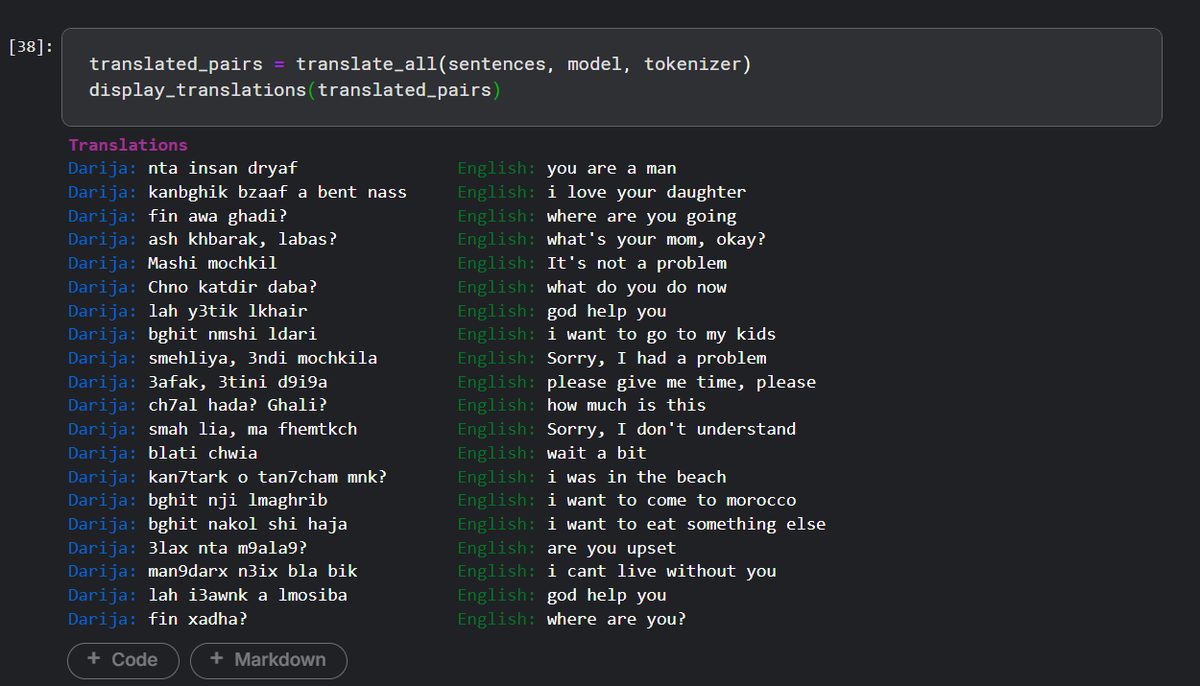
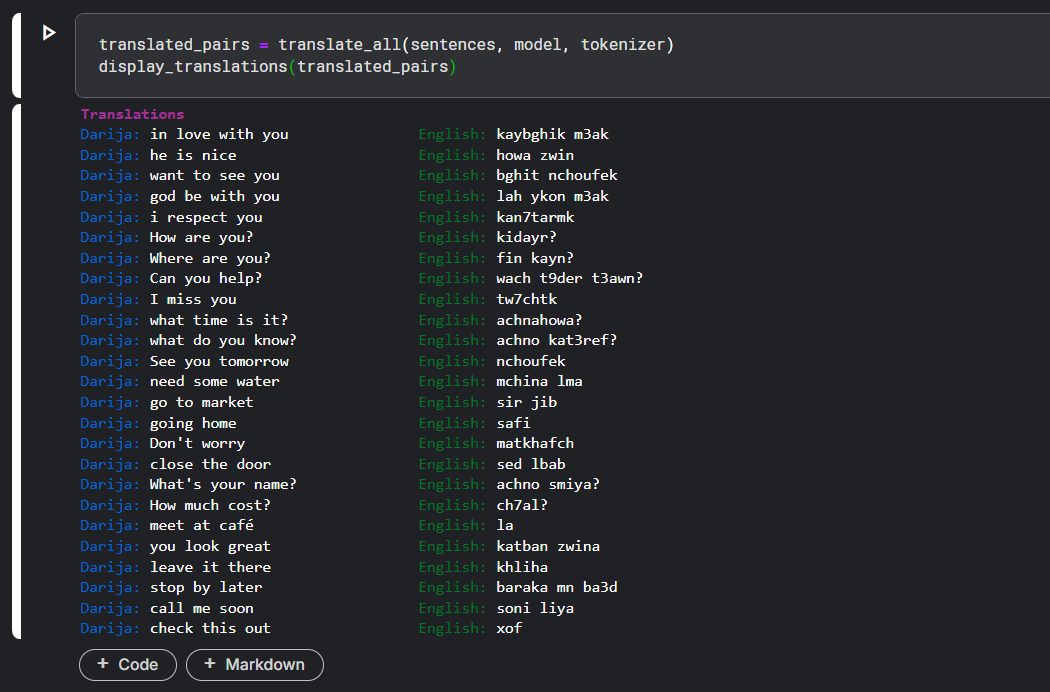
Input
bghit nji lmaghrib
Output
i want to come to morocco
Tech stack
Encoder–decoder Transformer, training, and beam search
GPT-2 tokenizer with added special tokens
Interactive translation app with ranked hypotheses
Dependency and environment management
What I learned
- Decoding strategy matters as much as the model for final output quality
- Label smoothing curbs overconfidence — especially on a low-resource language
Limitations
- Limited parallel data for Darija; quality bounded by the corpus