LunarLander RL
Eleven Deep-RL Methods on One Benchmark
DQN to SAC, each as one readable file, landing the same module under the same evaluation.
- PPO 276.4 ± 18.2
- Continuous lander solved in 1.5 min
- DQN 200+ at 50k steps
Built with PyTorchGymnasiumBox2D
 NumPyMatplotlib
 pytest
Overview
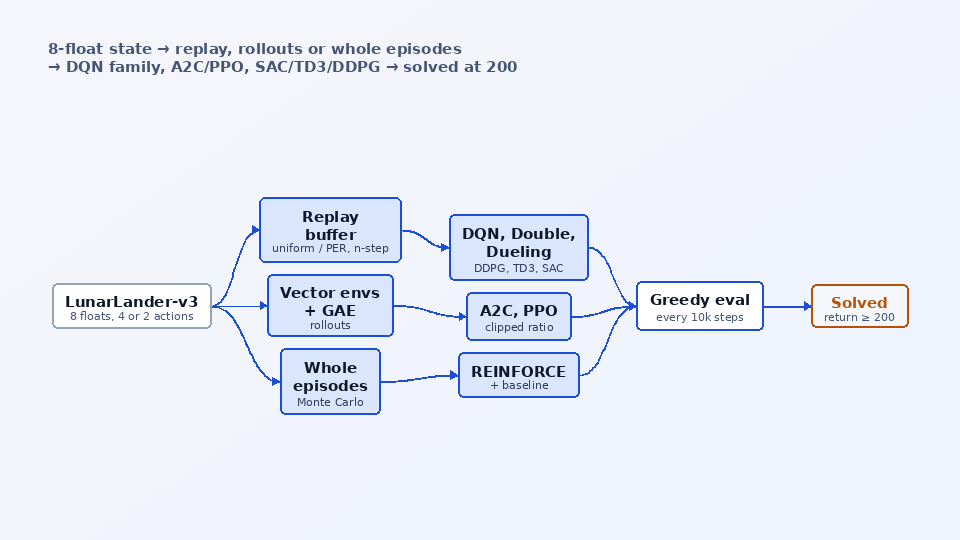
LunarLander is the step after CartPole: an 8-float state, a sparse +100 for coming to rest, a -100 crash, fuel costs, and a hover plateau that traps many agents. I used it to implement the classic deep-RL methods one file each and compare them honestly: DQN with its double and dueling variants, prioritized replay and 3-step returns, REINFORCE with a baseline, A2C, PPO and discrete SAC on the 4-button lander, and DDPG, TD3, SAC and Gaussian PPO on the 2-throttle continuous one.
Each algorithm is 60-120 lines with its update rule written as equations in the docstring, the networks are small MLPs, and one Config dataclass describes any run. All methods share the environment, the seeds, a Tracker that runs a greedy evaluation every 10,000 steps on fixed unseen episodes, a final 20-episode score, the curves and the comparison table. 49 tests check the buffers, GAE and log-probabilities, and that every agent learns a bandit.
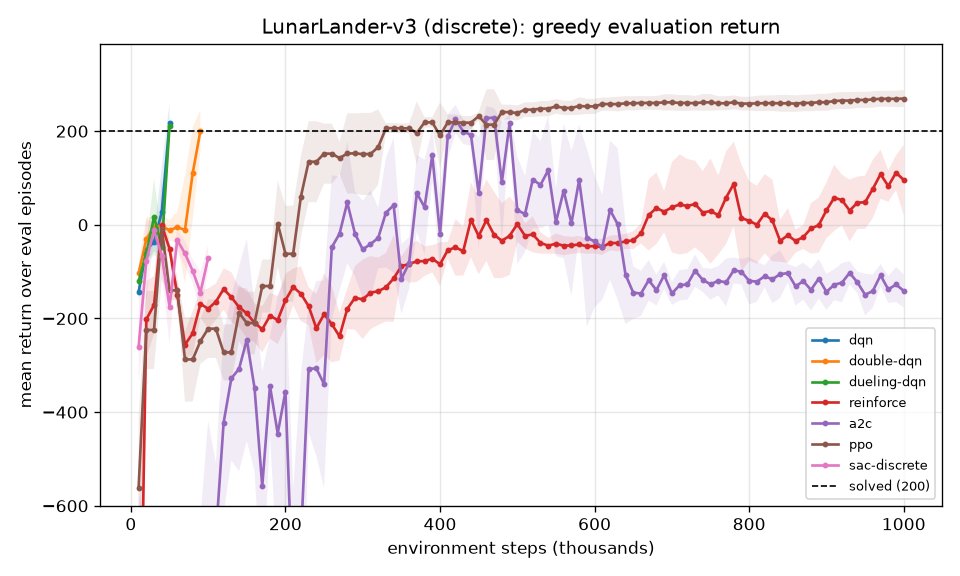
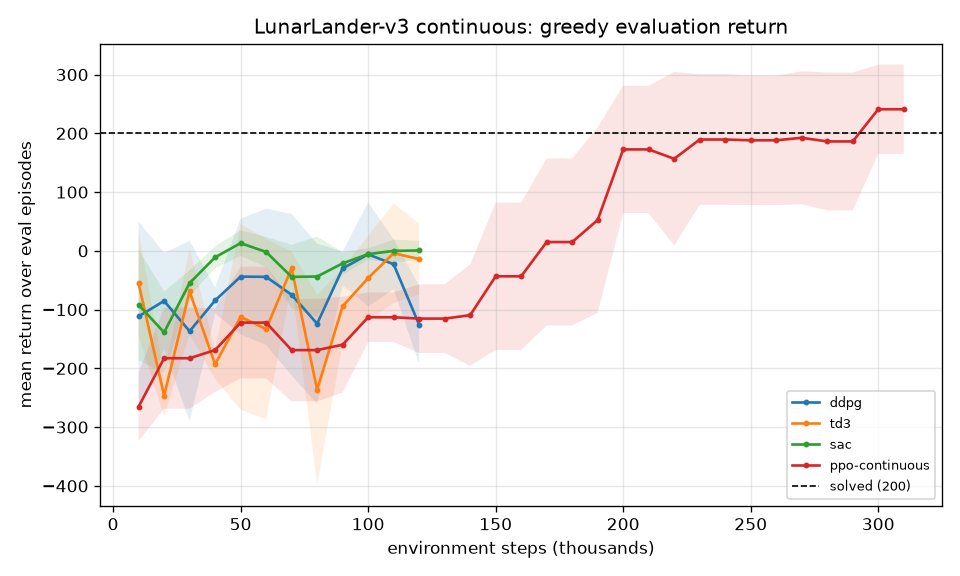
On one CPU thread, PPO is the most reliable (276.4 +- 18.2 after solving at 330,000 steps) and its Gaussian version solves the continuous lander in 1.5 minutes. DQN and dueling DQN solve at 50,000 steps, double DQN at 90,000. A2C reaches 200 and then collapses, REINFORCE climbs slowly, and the off-policy continuous methods are still hovering when their 120,000-step budgets run out.
The question
Which of the classic deep-RL algorithms land the module on one CPU thread in minutes, and what do their curves show about sample efficiency versus stability?
Key features
- Eleven methods behind one
--methodflag: dqn, double-dqn, dueling-dqn (with PER and 3-step returns), reinforce, a2c, ppo, sac-discrete, ddpg, td3, sac and ppo-continuous. - One Config dataclass for every hyperparameter, with presets per method and
--set key=valueoverrides; every run saves its config, weights and metrics. - A shared replay loop for the off-policy methods with uniform or prioritized (sum-tree) replay and n-step returns, and a shared rollout collector with GAE for A2C and PPO on 8-16 vectorised environments.
- Truncation bootstrapped everywhere: replay buffers store done only on a real crash or landing, and rollouts add gamma V(final_obs) at the 1,000-step time limit.
- One evaluation protocol: greedy actions, periodic 10-episode evaluations on fixed seeds, a final 20-episode score on other seeds, and random and PID-controller baselines on the same episodes.
lunarlander-comparebuilds the results table and curves against steps and minutes;lunarlander-playandscripts/make_gifs.pyrecord landings, before/after pairs and the solved-methods grid.- 49 pytest tests, six example scripts and a Kaggle/Colab notebook that explains each update rule from the package source and reruns the methods with larger budgets.
How it works
The environment
LunarLander-v3 gives an 8-float state (position, velocity, angle, angular velocity, leg contacts). Its reward is a potential-based shaping term minus fuel, plus +100 for resting and -100 for crashing; the dense shaping is what makes the task learnable in 10^5 steps.
Value methods on replay
DQN regresses Q(s, a) on r + gamma max Q_target(s') from a 50,000-transition buffer with a target network copied every 250 updates. Double DQN lets the online net pick a' and the target net score it; dueling DQN adds Q = V + A - mean A, prioritized replay by TD error with importance weights, and 3-step returns.
Policy gradient and actor-critic
REINFORCE pushes up log pi(a|s) by the return-to-go minus a learned V(s) over whole episodes. A2C uses GAE advantages from 16-step rollouts of 8 envs with one gradient step per rollout; PPO collects 16 x 1024 steps and takes 4 epochs of clipped-ratio minibatch updates.
Maximum-entropy and deterministic actors
Discrete SAC sums exactly over the 4 actions with a learned temperature. On the continuous lander DDPG climbs the critic's gradient dQ/da with Gaussian exploration noise, TD3 adds twin critics, target smoothing and a delayed actor, and SAC uses a tanh-Gaussian actor with reward plus alpha times entropy.
Track and compare
Every 10,000 steps the greedy policy plays 10 fixed episodes; a mean of 200 or more counts as solved and can stop training. A final 20-episode evaluation on unseen seeds fills the table, next to the random (-142.7) and PID-controller (265.9 / 288.2) baselines.
Examples
Input
lunarlander-eval --baseline heuristic # and --baseline random
Output
heuristic (gymnasium's PID controller): 265.9 +- 35.4 discrete, 288.2 +- 16.9 continuous random actions: -142.7 +- 80.1
Tech stack
Networks, actors, critics and every update rule
LunarLander-v3, discrete and continuous, with SyncVectorEnv for A2C and PPO
The lander physics behind the environment
Replay buffers, sum tree for prioritized replay, metrics
Training and evaluation curves against steps and minutes
49 tests: buffers, GAE, log-probabilities, every agent learns a bandit
What I learned
- The 1,000-step truncation must be bootstrapped, not treated as terminal: otherwise a hovering agent learns that hovering is worth zero, which slows escaping the hover plateau
- Stopping at the first 10-episode evaluation >= 200 is optimistic: dueling DQN stopped at 212 but scored 167.1 on 20 fresh episodes, which is why the table uses a final evaluation on unseen seeds
Limitations
- One seed and short CPU budgets per method: the table shows that each method learns and roughly how fast, not a ranking
- The off-policy continuous methods ran with one update every two steps and 128x128 networks to fit one CPU thread, and none of them solved the task in that budget
Keywords
reinforcement learning · LunarLander · Gymnasium · Box2D · DQN · double DQN · dueling DQN · prioritized experience replay · REINFORCE · A2C · PPO · SAC · TD3 · DDPG · PyTorch