STT Workbench
Speech-to-Text Approaches in PyTorch
Six ways to turn speech into text, built small enough to watch each one learn on a CPU.
- CTC 2.4% WER (toy)
- 15.1% WER on FSDD with an LM
Built with PyTorchtorchaudioBeam search
 ONNX
 Hugging Face Transformers
 NumPy
 pytest
 Kaggle
Overview
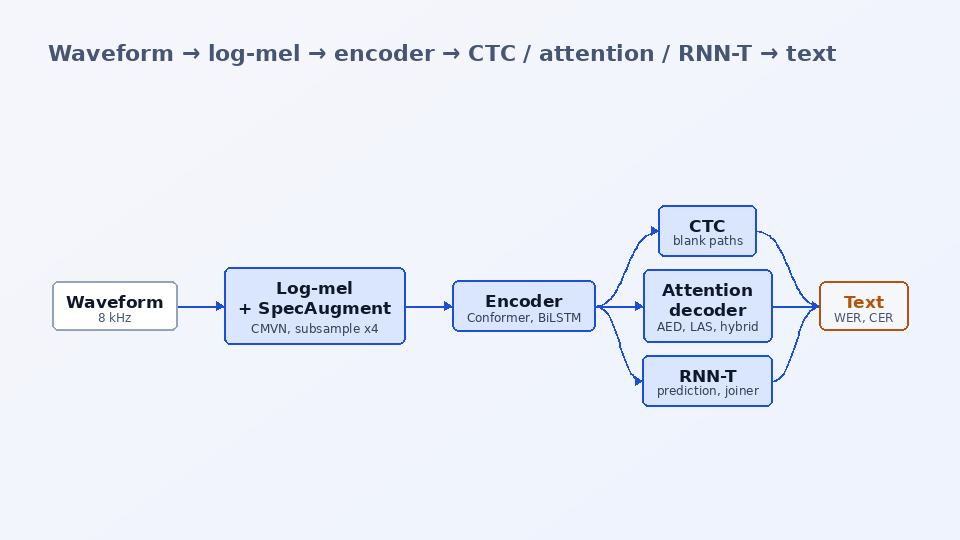
Automatic speech recognition has several families of models that solve the same hard problem, aligning a long sequence of audio frames with a short sequence of characters, in different ways. I wanted to see those differences for myself rather than read about them, so I wrote each approach in one small PyTorch code base where they share the front end, the encoders, the trainer and the evaluation.
The models are CTC, an attention encoder-decoder, Listen-Attend-Spell, hybrid CTC/attention and an RNN-Transducer, on BiLSTM, Transformer or Conformer encoders, plus wrappers for fine-tuning wav2vec2 and Whisper in the notebook. Every decoding algorithm is there too: greedy, CTC prefix beam search with an n-gram language model, attention beam search with CTC prefix scoring, and RNN-T greedy and modified beam search. The models have 1 to 1.3 M parameters by default.
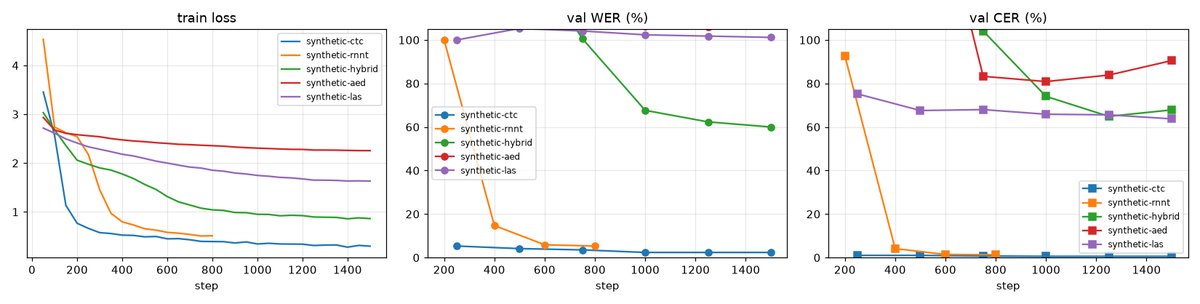
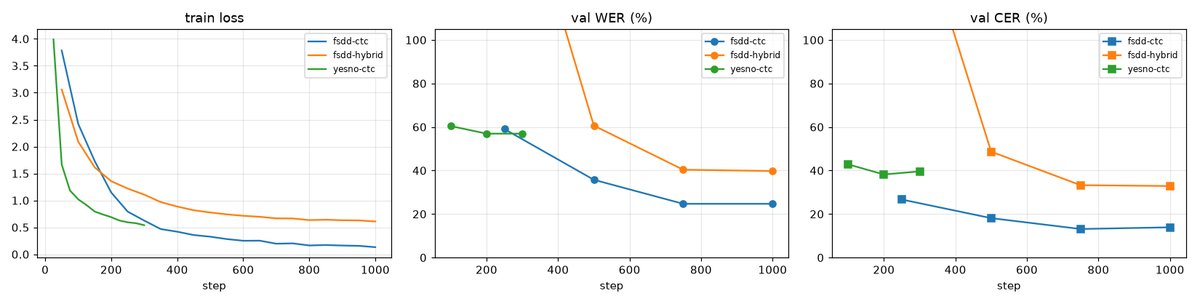
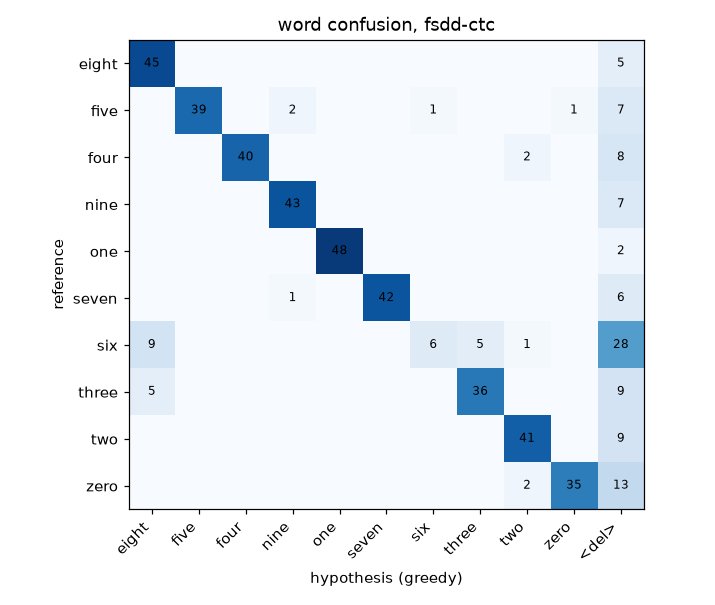
I tested it on simple 8 kHz data that trains in minutes on a CPU: a synthetic toy language, the Free Spoken Digit Dataset and YESNO. CTC reaches 2.4% WER on the toy language; on FSDD with a held-out speaker the CTC model gets 24.7% WER greedy and 15.1% with beam search plus a character 5-gram LM. These runs show that each approach learns and that the decoders work; they are not benchmarks, and real training belongs in the Kaggle/Colab notebook.
The question
If CTC, attention and transducer models share the same front end, encoders and trainer, what does each one actually need in order to learn the alignment between audio frames and text?
Key features
- Five trainable models behind one flag: CTC, attention encoder-decoder, LAS with location-aware attention, hybrid CTC/attention and RNN-Transducer.
- Three encoders any model can use, BiLSTM, Transformer and Conformer, after a log-mel front end with CMVN, SpecAugment and 4x convolutional subsampling.
- Every decoder: greedy, CTC prefix beam search with an interpolated n-gram LM, attention beam search with CTC prefix rescoring, and RNN-T greedy and modified beam search.
- Built-in datasets written or downloaded by one command (synthetic toy language, YESNO, FSDD, LibriSpeech, LJSpeech, Common Voice) with duration-bucketed batching.
- WER / CER evaluation with aligned worst utterances, a word confusion matrix and a script that compares decoders on the same checkpoint.
- ONNX export of the encoder and CTC head, wav2vec2 and Whisper fine-tuning wrappers, and a Kaggle/Colab notebook generated from the package source.
- 80 tests in about 10 seconds on a CPU, including a case where greedy CTC decoding is wrong and prefix beam search is right.
How it works
Front end
The waveform becomes an 80-bin log-mel spectrogram, normalised per utterance (CMVN) and masked in time and frequency by SpecAugment during training.
Encode
Two strided convolutions subsample the frames by four, then a BiLSTM, Transformer or Conformer stack builds contextual acoustic features.
Align frames with tokens
CTC sums over all frame paths that collapse to the transcript; attention decoders learn a soft alignment with cross-attention; the RNN-T joins the encoder with a prediction network over a monotonic lattice.
Train
Character or SentencePiece tokens, Adam with warm-up, duration-bucketed batches, validation WER / CER at every evaluation, and checkpoints that can be resumed.
Decode and score
Greedy or beam search, optionally fused with an n-gram LM; stt-eval aligns hypotheses with references and prints WER, CER and the worst utterances.
Examples
Input
stt-train --data-dir data/synthetic --sample-rate 8000 --model ctc --encoder conformer --d-model 96 --n-layers 4 --max-steps 1500 --output-dir checkpoints/ctc && stt-eval data/synthetic/val.jsonl hyps.jsonl
Output
val WER 2.4%, CER 0.6% (1.04 M parameters, 20 min on one CPU with two threads)
Input
python scripts/compare_decoders.py # same CTC checkpoint, 166 FSDD validation clips
Output
greedy: 24.7% WER | beam 8: 24.1% | beam 8 + character 5-gram LM (weight 0.3): 15.1%
Tech stack
Every model, encoder, loss and search algorithm
RNN-T loss (optional extra)
Beam search
CTC prefix beam search, attention beam search with CTC rescoring, RNN-T modified beam search
Export of the encoder and CTC head
wav2vec2 and Whisper fine-tuning wrappers (optional extra)
Synthetic toy-language generation
80 tests, about 10 seconds on a CPU
Generated notebook for real training on a free GPU
What I learned
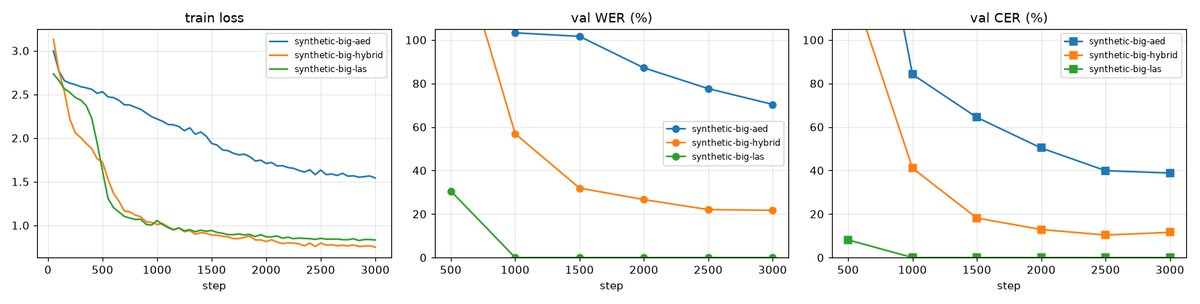
- CTC and RNN-T get a monotonic alignment for free, while attention decoders have to discover where to look, which costs data and steps
- A language model only helps when the language has structure: it cut FSDD WER from 24.7% to 15.1% and changed nothing on random-letter words
Limitations
- All results are short CPU runs on 8 kHz toy, FSDD and YESNO data, not benchmarks; no LibriSpeech numbers and no pretrained weights are published
- The YESNO run (42 training clips) stays at 56.9% WER; it only checks that the pipeline runs on real audio
Keywords
speech recognition · ASR · speech-to-text · CTC · RNN-Transducer · RNN-T · Listen Attend and Spell · attention encoder-decoder · hybrid CTC/attention · Conformer · BiLSTM · Transformer · prefix beam search · n-gram language model · SpecAugment · log-mel spectrogram · WER · CER · wav2vec2 · Whisper · PyTorch · ONNX · FSDD · LibriSpeech