Text2Image
Twelve Text-to-Image Architectures Side by Side
The main ways images are generated from text today, implemented with the same data, text encoder, loop and scorer, so only the architecture changes.
- 13 models compared
- U-Net: 100% attribute accuracy
- One-step sampling in 9 ms
Built with PyTorchCustom Transformers
 NumPy
 pytest
Overview
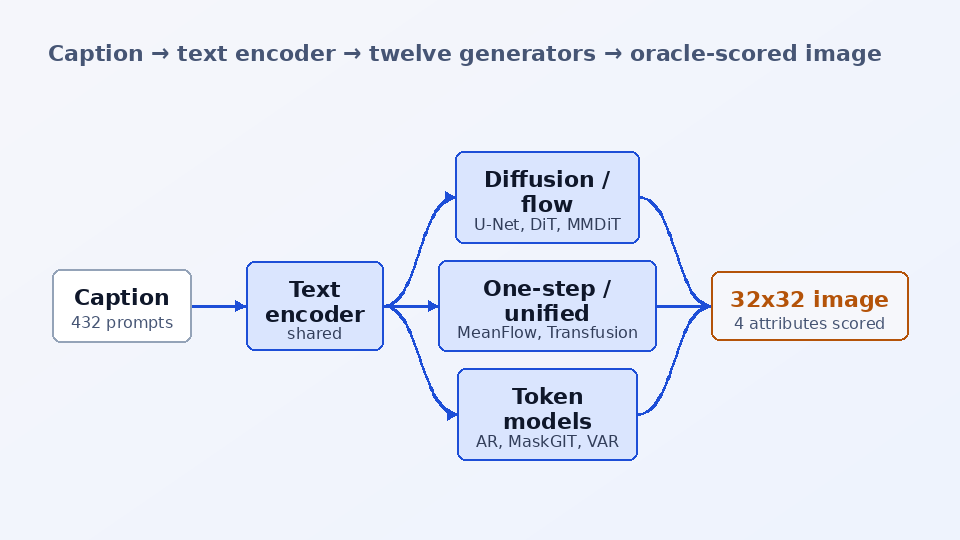
Text-to-image systems are built from a handful of architecture families, from the Stable Diffusion U-Net to FLUX-style MMDiT, one-step MeanFlow, Transfusion-style unified models, VAR's next-scale prediction and MAR's continuous-token autoregression, and the papers describe them at a scale where nothing can be compared on a laptop. I implemented twelve of them side by side in PyTorch, each small enough to train on a CPU, behind the same interface: model.loss(images, tokens) and model.generate(tokens, cfg_scale).
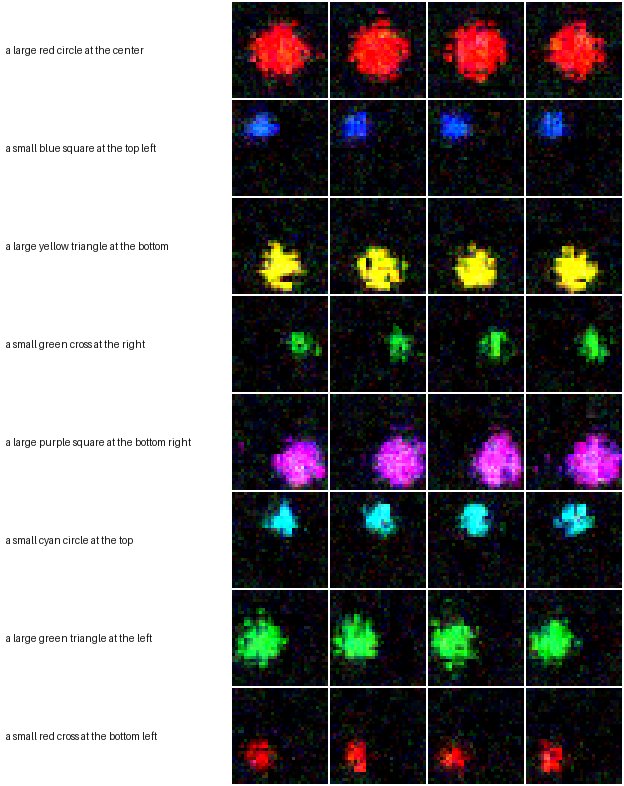
Every model shares the same data, text tokenizer and encoder, training loop (AdamW, warm-up plus cosine schedule, EMA weights, gradient clipping) and classifier-free guidance, so the only thing that changes between runs is the architecture. The benchmark is a procedural captioned-shapes task: one coloured shape on a dark background at 32x32, described by 432 prompts over four independent attributes (size, colour, shape, position). A small CNN oracle reads those attributes from an image at about 100% accuracy and scores generated images per attribute and on all four at once, a toy version of GenEval.
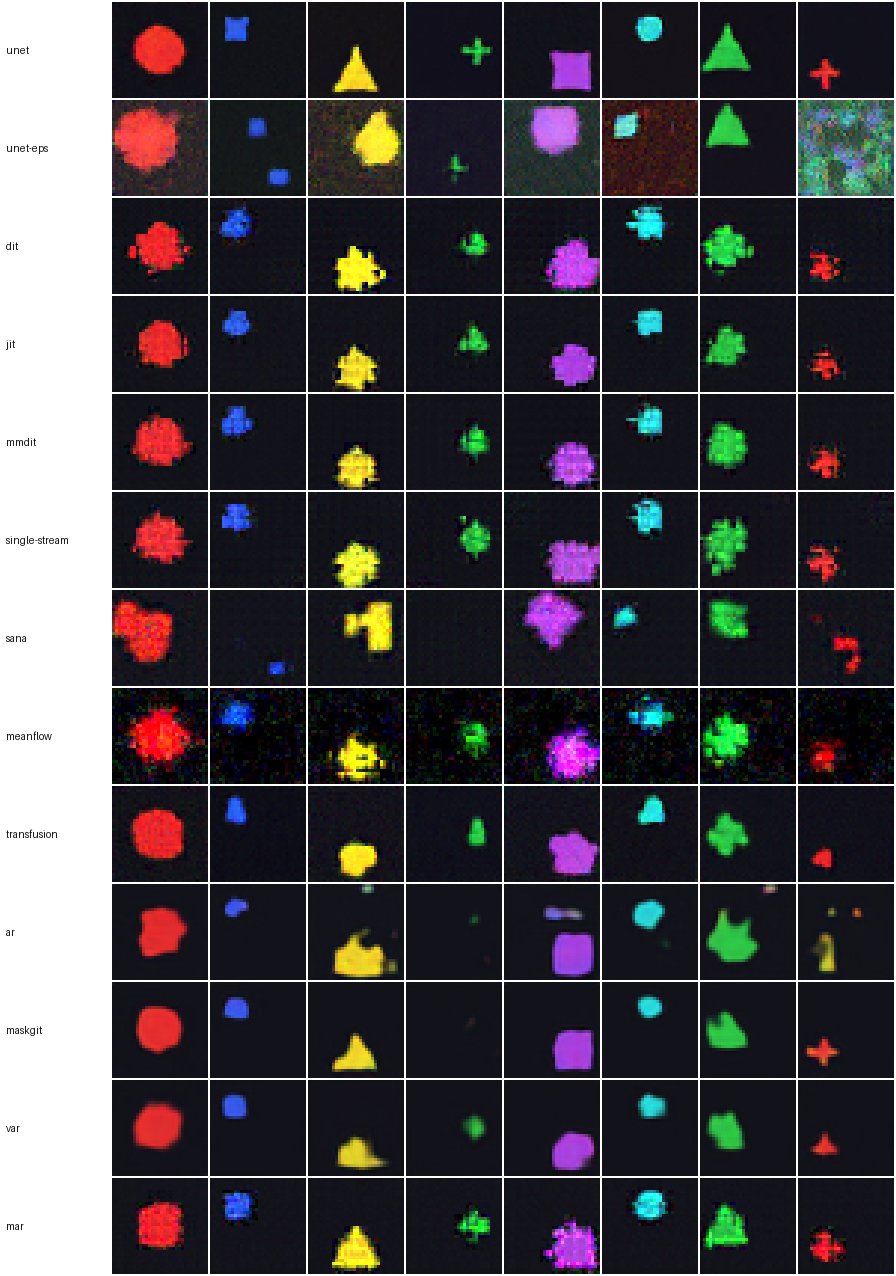
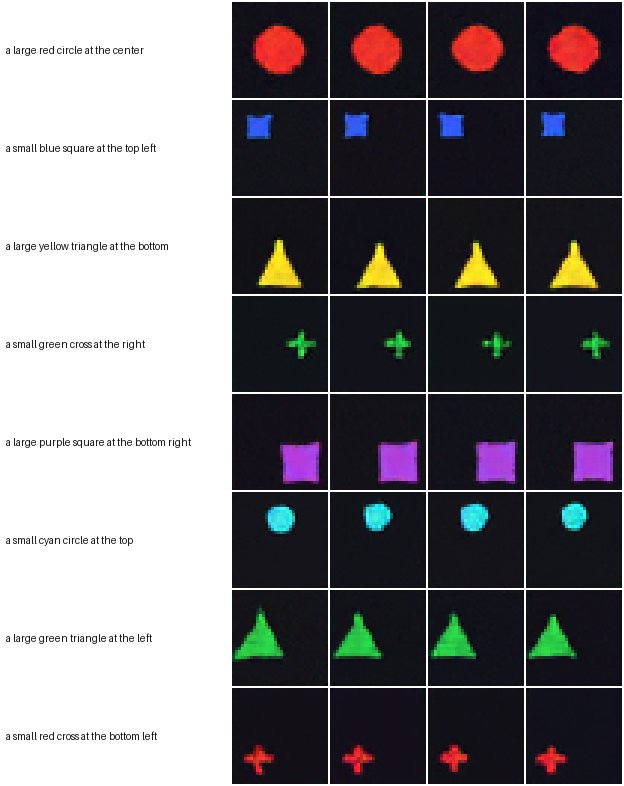
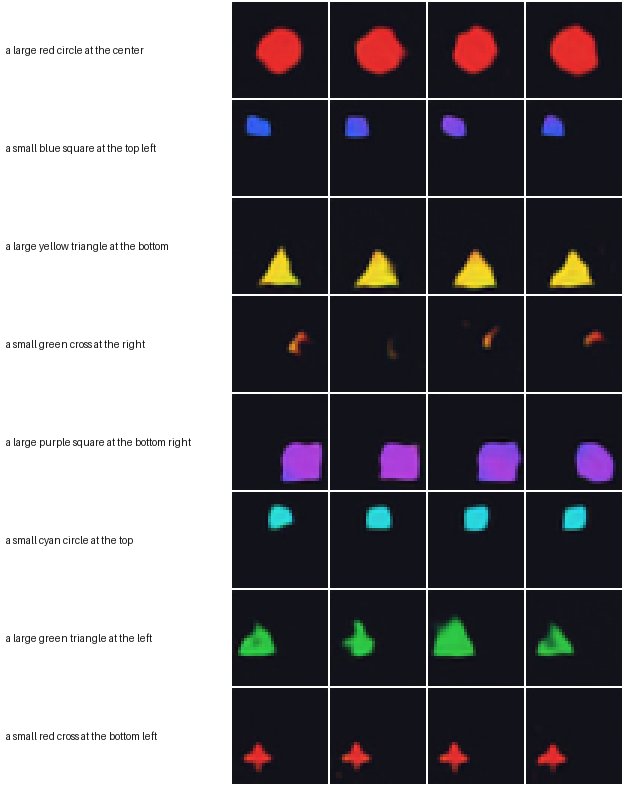
After 2,000 steps at batch 32, the v-prediction U-Net gets every attribute right (100%), the token models follow (MaskGIT 77%, MAR 72%, VAR 65%) and the pixel-space flow transformers get the layout right but blur the shapes (DiT 25%, MMDiT 34%). The prediction target turned out to be decisive: the same U-Net with ε-prediction scores 3%, and JiT's clean-image prediction doubles DiT's score. MeanFlow matches DiT with one network evaluation instead of 30.
The question
When the data, text encoder, training loop and evaluation are held fixed, how do the main text-to-image architectures compare at binding every word of a caption to the right visual property?
Key features
- Six continuous-pixel models: U-Net + DDPM with v or ε prediction, DiT with cross-attention (PixArt-α), JiT (x-prediction), MMDiT (SD3 / FLUX double-stream), a single-stream DiT (FLUX single blocks, Z-Image) and SANA with linear attention, Mix-FFN and no positional embedding.
- MeanFlow, which learns the average velocity with a forward-mode JVP target and generates in one network evaluation, with guidance folded into training.
- Transfusion: one transformer that reads [caption; noisy patches] with a causal mask on text and bidirectional attention on the image, trained as a caption language model and an image denoiser at once.
- Four token models over a VQ-VAE: next-token autoregression, MaskGIT's confidence-based parallel decoding, VAR's next-scale prediction over a multi-scale residual quantizer, and MAR's continuous tokens with a per-token flow head.
- A shared word tokenizer and small transformer text encoder (a CLIP / T5 stand-in), one training loop and classifier-free guidance for every family.
- Automatic evaluation with a CNN oracle: per-attribute accuracy and the fraction of images with all four attributes correct, plus a one-command script that trains the oracle, the tokenizers and all 13 models and builds the results folder.
- 44 tests on shapes, gradients, sampling, tokenizers, the JVP, attention masks and overfitting, and a literature survey that maps each 2025-2026 production system to the file that implements its idea.
How it works
Render and caption
Each training image is one shape drawn procedurally at 32x32 from a prompt such as 'a small blue square at the top left', with random jitter in position and scale; a pre-rendered bank keeps the CPU loop fast.
Encode the text
A word tokenizer and a small transformer produce a token sequence for cross or joint attention and a pooled vector for adaLN modulation. 10% of prompts are replaced by the null prompt so that guidance works at sampling.
Train with one loss per family
Diffusion and flow models regress ε, v, x0 or a velocity on noised pixels; MeanFlow regresses the average velocity through the MeanFlow identity; token models predict VQ codes (next token, masked tokens or next scale) or run a flow head per continuous token.
Generate with guidance
Every generate() combines conditional and unconditional outputs (noise, velocity, logits or flow-head velocity) at scale 3.0; MeanFlow samples in one step, MaskGIT in about 12, the diffusion models in 30.
Score with the oracle
A CNN trained on real images reads colour, shape, position and size from each generated image for 128 random prompts; a model only scores on 'all 4 correct' if it binds every word to the right property.
Examples
Input
transfusion.complete_caption("a small blue")
Output
"a small blue square at the top right"
Input
text2image-eval --ckpt runs/unet/model.pt --oracle runs/oracle/model.pt --n 128
Output
color 100% shape 100% position 100% size 100% all 4 correct 100%
Tech stack
All twelve architectures, the VQ-VAE, the text encoder and the training loop
Custom Transformers
DiT, MMDiT, single-stream, SANA, Transfusion and the token models, written by hand
Procedural rendering of the captioned-shapes dataset
44 tests, including the JVP of MeanFlow and the attention masks of Transfusion and VAR
What I learned
- Convolutions still have the right inductive bias for small, pixel-exact shapes; transformers trade it for scalability that only pays off far beyond this task
- Token models with a VQ decoder are the strongest transformers at equal steps, because the transformer only has to pick 64 codes
- SANA's no-positional-embedding design needs depth: with 4 blocks on an 8x8 grid, position stays at chance
Limitations
- Toy scale: 32x32 pixel space, about 1 M parameters, 2,000 CPU steps, scores on 128 prompts with about ±4% standard error, and most models have not converged; rankings at production scale (billions of parameters, VAE latents) differ
Keywords
text-to-image · Stable Diffusion · U-Net · DiT · MMDiT · FLUX · SANA · JiT · MeanFlow · Transfusion · autoregressive image generation · MaskGIT · VAR · MAR · VQ-VAE · flow matching · rectified flow · classifier-free guidance · v-prediction · GenEval · PyTorch